Flood damage doesn’t respect borders – but how you respond to it absolutely should. The restoration protocols, building codes, climate conditions, and emergency timelines that apply in Canada look noticeably different from what homeowners face in the southeastern United States. Understanding those differences can mean the gap between a successful dry-out and a mold-compromised structure.
Climate and Moisture: The Core Difference
In Canada, the most common water damage events stem from spring snowmelt, ice damming, and frozen pipe failures. The cold climate actually works in a restorer’s favour in one key way – lower ambient humidity slows secondary damage after extraction. A saturated wall cavity in Ontario in February will absorb and release moisture more slowly than the same wall in a humid subtropical environment.
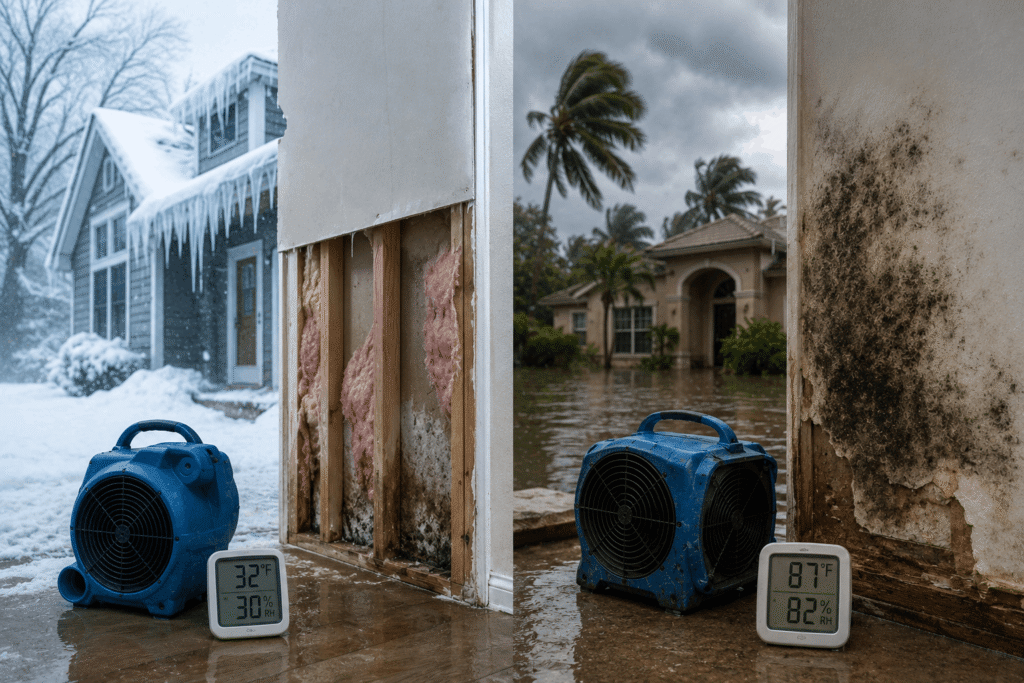
The US Southeast is a different story entirely. States like Florida, Georgia, and the Carolinas sit in climate zones where outdoor relative humidity regularly exceeds 80% even on dry days. When a structure takes on water from a storm surge, roof failure, or plumbing event, the ambient moisture in the air actively works against the drying process – saturated materials can begin supporting mold growth in as little as 24 hours, compared to 48–72 hours in drier inland climates.
According to NOAA’s National Centers for Environmental Information, the Southeast coast is also the most expensive region in North America for weather-related property damage, with hurricanes and tropical storms driving billions in annual losses across Florida alone.
Building Materials and Construction Differences
Canadian residential construction is dominated by wood-frame builds with vapour barriers – materials designed to manage moisture in cold climates. Drywall, subfloor, and insulation in Canadian homes behave predictably when wet and follow established IICRC drying protocols reasonably well.
In coastal Florida and the broader Southeast, you encounter a wider variety of construction types:
- Concrete block (CBS) construction – common throughout Florida – absorbs water into the block itself, requiring significantly longer drying cycles than wood-frame structures
- Older homes built before 1980 frequently contain asbestos-bearing materials (floor tile, pipe wrap, ceiling texture) that become a remediation concern the moment water damage exposes them
- Crawl-space foundations – common in Georgia and the Carolinas – create ground-moisture intrusion pathways that simply don’t exist in basement-heavy Canadian builds
These material differences mean restoration teams working the Southeast need different equipment loads, extended drying timelines, and more frequent moisture mapping checkpoints than a typical Canadian job requires.
Emergency Response Windows
In Canadian restoration, particularly outside major urban centres, a 4–6 hour response window for emergency extraction is generally acceptable outside of catastrophic multi-structure events. The cold climate naturally delays secondary damage.
In coastal Florida, the response window is compressed to 2–4 hours for the same reason that humidity accelerates damage. Providers handling Daytona Beach water damage restoration operate with 24/7 emergency dispatch precisely because storm events in Volusia County – from direct hurricane landfalls to offshore tropical depressions – can flood multiple properties simultaneously while ambient conditions are already hostile to any delay.
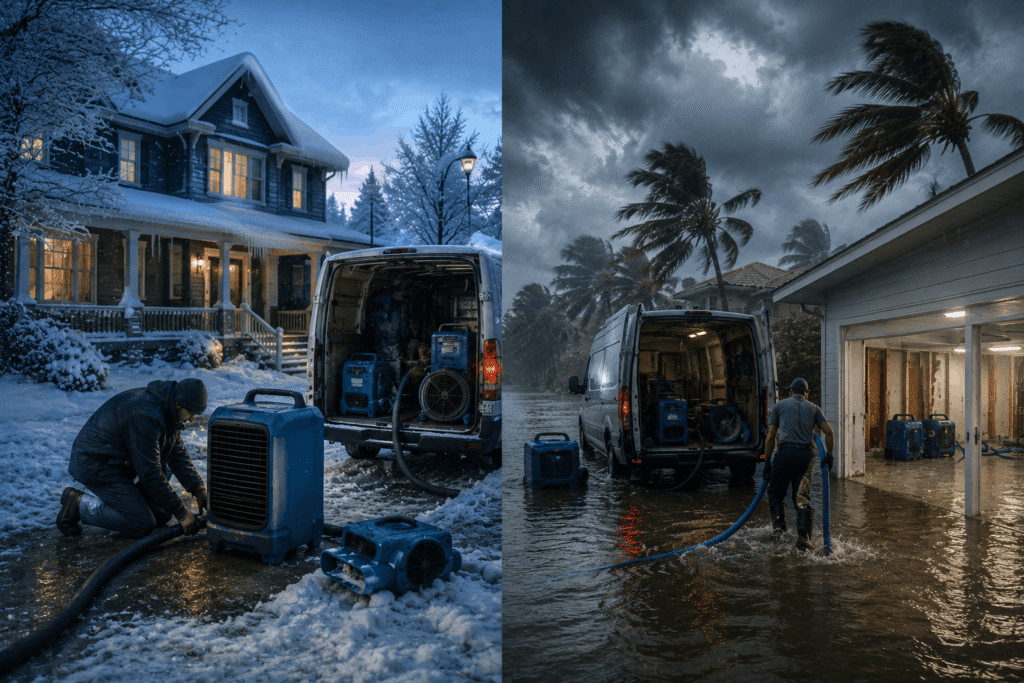
That urgency is built into how Southeast US restoration companies staff, equip, and price their services. Truck-mounted extraction units and same-day structural drying deployment aren’t luxuries in this market – they’re the baseline expectation.
Insurance and Documentation Protocols
Both Canadian and US restoration contractors work within insurance claim ecosystems, but the specifics differ significantly.
In Canada, most residential flood claims flow through insurers offering National Flood Program equivalents or private overland flood coverage – a relatively recent development, as many Canadian policies historically excluded overland flooding entirely. Claims documentation requirements tend to be thorough but standardised.
In the US, the National Flood Insurance Program (NFIP) administered by FEMA handles the majority of residential flood claims in high-risk zones, including most of coastal Florida. NFIP adjusters follow specific proof-of-loss requirements and depreciation schedules that experienced Southeast restoration contractors know how to document against – a knowledge gap that often costs homeowners thousands if they hire a contractor unfamiliar with the program.
What Both Markets Share: The IICRC Standard
Regardless of country or climate, professional water damage restoration in both Canada and the US is governed by the IICRC S500 Standard for Professional Water Damage Restoration. Any contractor working in either market should be certified to this standard and able to provide daily drying logs, moisture mapping documentation, and a written drying goal that specifies target moisture content for each affected material class.
If a contractor – on either side of the border – cannot produce this documentation, that’s a flag worth taking seriously.
Conclusion
The fundamentals of water damage restoration are universal: extract fast, dry completely, test before rebuilding. But the how varies enormously between cold Canadian climates and the humid, storm-exposed Southeast US coast. Homeowners and property managers in both regions are best served by working with contractors who understand not just the general process, but the specific climate, construction, and regulatory environment they’re operating in.
Brooklin Restoration serves the greater Toronto and Durham Region area with certified water damage extraction, structural drying, and mold remediation services. IICRC-certified. Available 24/7.
Leave a Reply