Every hurricane season, homeowners ask the same question right before storm warnings start: “Am I actually at risk?” The honest answer depends on where you live – and not just coastal vs. inland in the simple sense. The kind of water threat headed your way, and what you should do to prepare for it, looks different depending on your specific exposure.
A home in coastal Alabama is bracing for a different threat than a home in the Carolina low country, and both face something different again from a property three hundred miles inland that floods purely from rainfall runoff. Knowing which threat applies to you – before the storm, not after – changes what you should actually be doing to prepare, and what kind of damage to expect if prep falls short.
Coastal Homeowners: Storm Surge Is Your Main Threat
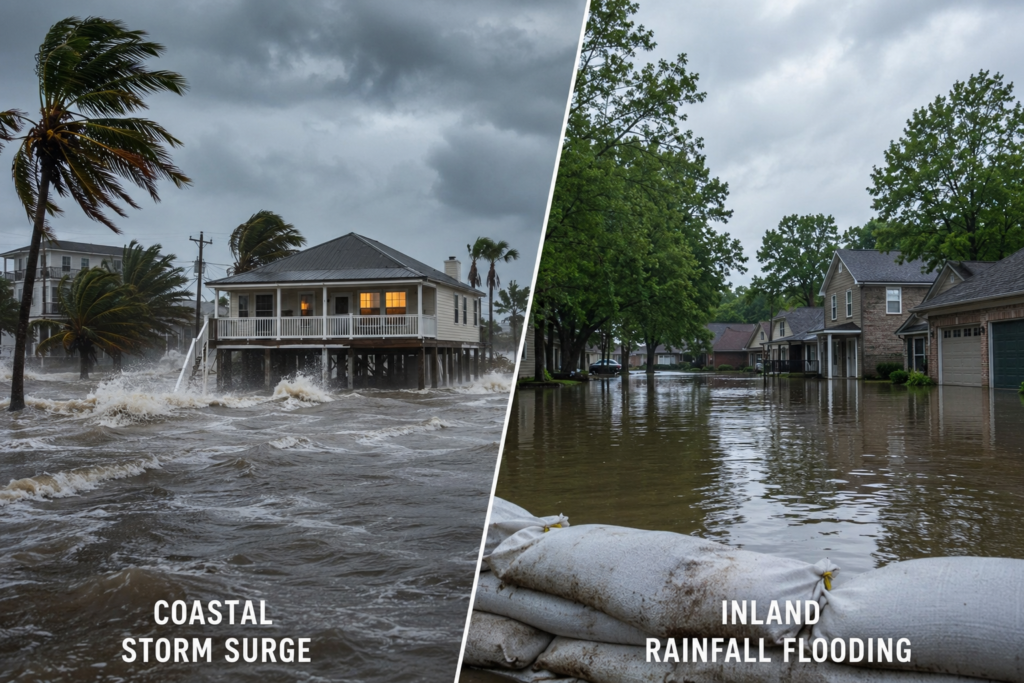
Along the immediate coastline, the dominant hazard isn’t rain – it’s storm surge, the wall of seawater that hurricane winds push onto land. According to NOAA, storm surge and inland flooding from heavy rain have historically been the leading causes of death during hurricanes, and surge can travel several miles inland along bays, rivers, and estuaries, not just at the beachfront.
If surge does reach your property, you’re dealing with saltwater intrusion, which behaves differently than fresh water. Saltwater accelerates corrosion in electrical systems and HVAC components, and it leaves behind a salt residue that can re-attract moisture long after a property looks dry. This is one of the reasons gray water removal and, in more severe storm surge cases, black water remediation require different handling and PPE than a typical indoor pipe leak – surge water often carries contaminants picked up from storm drains, soil, and standing floodwater on its way inland. Knowing this in advance helps you understand why coastal restoration jobs move differently than inland ones.
Inland Homeowners: Watch the Rainfall, Not Just the Storm Track
Move away from the coast, and the threat shifts from surge to rainfall. NOAA’s hurricane safety guidance is direct on this point: hurricanes are not just a coastal problem, and significant flooding impacts can occur hundreds of miles inland regardless of the storm’s wind category at landfall. A weakening tropical system can still stall over a region and drop a season’s worth of rain in 48 hours – which means watching the storm’s wind category alone can give inland homeowners a false sense of security.
For homeowners who do flood, inland flooding is often a slower-moving disaster – water that rises gradually from saturated ground and overflowing rivers rather than arriving in a single surge. That means basement flood recovery and crawlspace extraction become priorities, structural drying timelines tend to run longer because groundwater keeps seeping in after the rain stops, and there’s a higher risk of contaminated water if storm drains or septic systems back up – which is when sewage backup cleanup becomes part of the response alongside the flood itself.
Both Groups: Don’t Underestimate Wind-Driven Intrusion
Even homes that never see standing floodwater can take on significant water damage from wind alone. Hurricane-force winds drive rain sideways into roof systems, around window and door flashing, and into attic vents. This kind of damage tends to show up as ceiling staining, wet insulation, and slow leaks that aren’t obvious until mold has already started – which is why a post-storm moisture detection inspection matters even if your property “didn’t flood.” This applies to coastal and inland homeowners alike.
If you’re specifically on the Gulf Coast, Mobile AL Water Damage has a more detailed local breakdown of hurricane prep for homeowners dealing with the area’s storm surge exposure.
Why Prepping for the Right Threat Matters
In every one of these scenarios, the first 24–48 hours after a storm determine how much of the damage is repairable versus how much becomes a full gut-and-rebuild. Saltwater exposure, contaminated floodwater, and wind-driven moisture in wall cavities all start causing secondary damage – corrosion, mold, structural weakening – almost immediately. Knowing which threat you’re actually preparing for, rather than treating “hurricane prep” as one generic checklist, is what separates a fast recovery from a long, expensive one if the storm does cause damage.
Check Your Insurance Coverage Before the Forecast Turns
One of the most common – and costly – surprises for hurricane victims is discovering that their homeowners policy and their flood policy don’t cover the same things. Standard homeowners insurance typically excludes flood damage entirely, which is why FEMA’s National Flood Insurance Program exists as a separate policy for buildings and their contents. If a storm brings rising water – surge or rainfall flooding – that distinction can determine whether a major claim is covered at all.
This is exactly the kind of thing to sort out before hurricane season, not after the forecast turns ugly. You can check your flood risk and policy options directly through FEMA’s flood insurance program.
The Bottom Line
Hurricane prep isn’t one generic checklist. Coastal homeowners should plan around saltwater surge, inland homeowners should plan around slow-rising rainwater floods, and wind-driven intrusion is a risk for both. Knowing which threat actually applies to you – and prepping accordingly – is what separates a fast recovery from a long, expensive one if the storm does cause damage.
For a closer look at how the type of flooding itself changes the restoration approach once damage happens, see our breakdown of basement floods vs. storm floods vs. pipe bursts.
Leave a Reply